Introduction
Why do we remember some things but forget others? Why do emotions influence our decisions? Why do people behave differently in the same situation?
What Is Psychology?
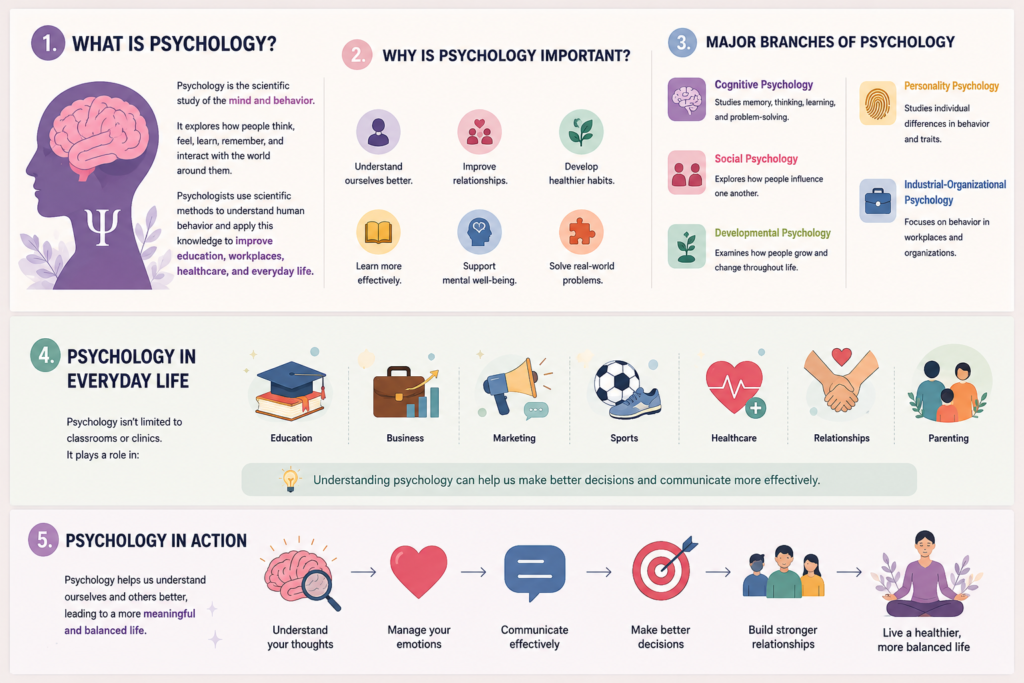
Psychology is the scientific study of the mind and behavior. It explores how people think, feel, learn, remember, and interact with the world around them.Psychologists use scientific methods to understand human behavior and apply this knowledge to improve education, workplaces, healthcare, and everyday life.
Why Is Psychology Important?
Psychology helps us:
- Understand ourselves better.
- Improve relationships.
- Develop healthier habits.
- Learn more effectively.
- Support mental well-being.
- Solve real-world problems.
Major Branches of Psychology
Cognitive Psychology
Cognitive psychology focuses on how people think, learn, remember, solve problems, and make decisions. It explores mental processes such as attention, perception, language, and memory. This branch helps researchers understand how the brain processes information and how people learn new skills.
Example: Understanding why you remember some facts for years but forget where you left your keys.
Social Psychology
Social psychology studies how our thoughts, feelings, and behaviors are influenced by the people around us. It examines topics like peer pressure, group behavior, stereotypes, social interactions, and relationships.
Example: Choosing a restaurant because your friends recommend it or feeling nervous when speaking in front of a crowd.
Developmental Psychology
Developmental psychology explores how people grow and change throughout their lives—from infancy and childhood to adulthood and old age. It studies physical, emotional, cognitive, and social development at different stages of life.
Example: Understanding how children develop language skills or how older adults adapt to life changes.
Personality Psychology
Personality psychology examines the characteristics and traits that make each person unique. It studies how personality develops, how it influences behavior, and why people respond differently to similar situations.
Example: Why one person enjoys meeting new people while another prefers spending time alone.
Industrial-Organizational Psychology
Industrial-Organizational Psychology applies psychological principles to the workplace. It focuses on improving employee well-being, motivation, leadership, teamwork, job satisfaction, recruitment, and organizational performance.
Example: Helping companies create a positive work environment or designing better employee training programs.
Psychology in Everyday Life
Psychology isn’t limited to classrooms or clinics. It plays a role in:
- Education
- Business
- Marketing
- Sports
- Healthcare
- Relationships
- Parenting
Understanding psychology can help us make better decisions and communicate more effectively.
Conclusion
Psychology is much more than the study of mental illness—it’s the study of people. Whether you’re beginning your academic journey or simply curious about the human mind, learning psychology opens the door to understanding yourself and others.